Art & DT
What is our vision for DT?
At The Growth Learning Collective, our DT curriculum embodies the aims of the National Curriculum. Ensuring that all children:
- Develop the creative, technical and practical expertise needed to perform everyday tasks confidently and to participate successfully in an increasingly technological world
- Build and apply a repertoire of knowledge, understanding and skills to design and make high-quality prototypes and products for a wide range of users
- Critique, evaluate and test their ideas and products and the work of others
- Understand and apply the principles of nutrition and learn how to cook.
In our schools, DT inspires children to explore, design and create products and devices that help us navigate and make sense of the world. Linking to learning about nutrition and keeping healthy in science, cooking is taught to encourage children to try new flavours and develop independence in preparing their own meals and snacks. Utilising cross-curriculum links is a key part of embedding Design Technology in the forefront of children’s minds. For example, writing instructions about how to make a healthy sandwich, will foster both literacy skills due to writing about a real practical experience as well as embed the Design and making process to support memory of this key cookery skill. From the moment children join our schools in Early Years, design technology learning promotes a growth mindset – giving our children the confidence to be curious, take risks and see failure and redesign as a crucial part of learning. We see Design Technology as an opportunity to prepare our children to be citizens of the world, and a key thread of sustainability in our material choices instils a respect and care for the Earth. In an ever-changing world, DT gives our children the skills they need to be successful in the future.
What do DT lessons look like in our school and how do we plan lessons?
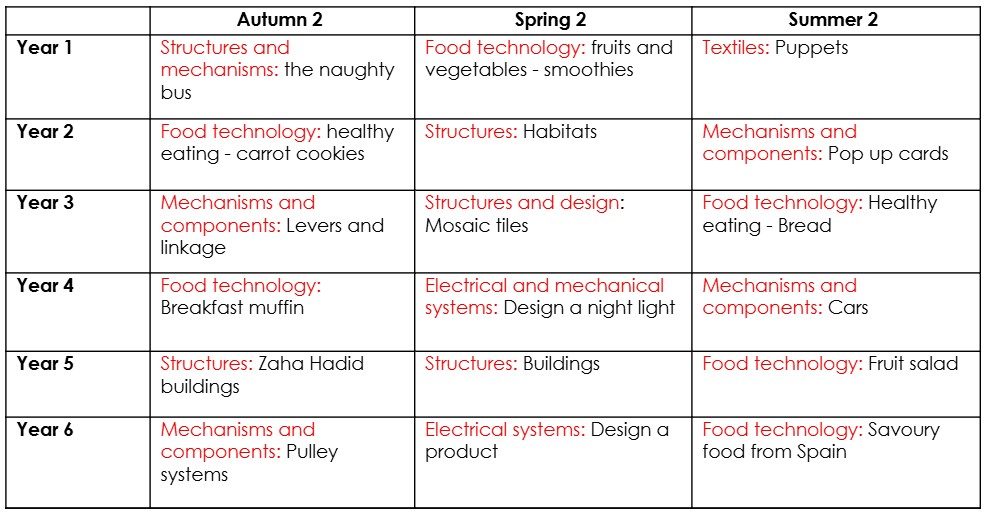
Design Technology is taught in three half terms of the academic year, and art is taught in the other three half terms. At The Growth Learning Collective, DT is taught in the second half of each term (Autumn 2, Spring 2 and Summer 2). Some DT units are taught weekly (e.g. pop-up cards in Year 2) whereas some units lend themselves better to being blocked into a whole day or a series of afternoons in one week due to the storage or resource requirements of the topic (this applies to food technology in particular).
Our curriculum is carefully sequenced so that children revisit and embed key learning before building on it in subsequent years. Units are ordered so that children have the essential prior knowledge they need to fully grasp new concepts - for example, in Year 4 children use a basic electrical circuit to design a specified product (a night light). In Year 6, children build on this prior learning to research different electrical products and design a new product using a circuit of their choice.
A condensed version of our school curriculum map (shown below) outlines the topic areas covered from Year 1 – Year 6.
In DT lessons, children learn key facts/information (substantive knowledge) through the evaluation of existing products and designs followed by exploration of their own ideas. Children work independently or in small groups to plan, carry out and evaluate designs and make projects to fulfil a specified design brief. Wherever possible, we relate learning to the children's everyday lives (e.g. Designing a nightlight for a child’s bedroom in Year 4 or making a pop up thank you card for an adult at home in one of our Year 2 units.)
In line with our teaching and learning policies, lesson begin with a recap of prior learning before breaking new learning into small, achievable steps. Children revisit learning multiple times over a unit so that they can commit it to their long-term memory.
What can you do to help your child at home?
Helping your child with Design Technology at home is all about noticing and wondering about the objects, products and foods in the world around you. When you’re in the kitchen, out on a walk or visiting new places, model thinking about what you can see and asking questions you’d like to find the answer to: ‘I wonder why your water bottle is metal and mine is made of plastic.’ Or ‘I wonder how they made this car move so fast around the track.’ You don’t have to know the answers to model the thinking skills that designers and makers use every day!