Maths
What is our vision for maths at Rotherfield?
At Rotherfield, we firmly believe that every child has the potential to succeed in mathematics. Our vision is to nurture confident, curious, and enthusiastic mathematicians who understand the relevance of maths in everyday life. We foster a positive mindset towards maths, encouraging children to explore, question, and enjoy the subject.
To achieve this, we follow a mastery approach to mathematics that breaks learning into small, manageable steps, ensuring deep understanding and sustained progress for all learners.
We believe that all children can achieve in mathematics and promote a growth mindset throughout the curriculum.
Our aim is to develop:
- Fluent, confident mathematicians with strong conceptual understanding;
- Critical thinkers who can reason mathematically, justify their thinking, and solve a range of problems;
- Lifelong learners who recognise the importance of maths in the wider world.
We provide a high-quality curriculum that is:
- Adaptive to the needs of all learners;
- Rich and balanced, promoting both depth and breadth of knowledge;
- Progressive, ensuring consistent development through each strand of the curriculum.
What do maths lessons look like in our school and how do we plan lessons?
Our maths curriculum is underpinned by the NCETM’s Five Big Ideas of Mastery: Coherence, Representation and Structure, Mathematical Thinking, Fluency, and Variation. We follow a blocked curriculum, meaning each key mathematical concept is taught in depth before moving on to the next.
We use Power Maths, a DfE-recommended scheme, to support our planning and teaching. Power Maths provides a consistent structure, aligned with our mastery approach, and encourages active engagement, reasoning, and problem-solving.
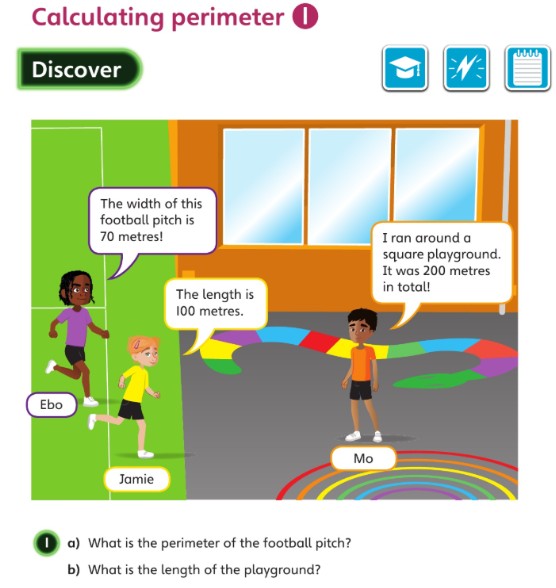
Each lesson includes the following:
- Discover: Children engage with a problem or puzzle to spark curiosity and activate prior knowledge.
- Share: Pupils discuss and compare methods, using representations to explain their thinking.
- Think Together: Guided practice allows pupils to deepen their understanding collaboratively.
- Practice: Independent tasks challenge children to apply what they’ve learned across different contexts.
- Reflect: Pupils consider what they’ve learned and how they approached the problem.
Supporting Fluency
In addition to daily maths lessons, we dedicate time to developing fluency in number through two programmes:
- Mastering Number (EYFS & Key Stage 1): A daily programme that builds strong number sense and confidence with number facts.
- Number Sense Maths (Key Stage 2): Focused on multiplication and division fluency, this programme develops automaticity and deep understanding of relationships between numbers.
What can you do to help your child at home?
Parental support plays a vital role in children’s success in mathematics. Here are a few ways parents can help:
1. Build Confidence:
- Talk positively about maths, even if you found it difficult yourself.
- Praise effort and perseverance as much as correct answers.
2. Practice Together:
- Regularly practise number bonds, times tables, and mental arithmetic at home.
- Use everyday opportunities such as cooking, shopping, or travel to explore maths together.
3. Use Online Tools:
-
Engage with platforms like Times Tables Rock Stars, BBC Bitesize, or Hit the Button.
4. Read the Calculation Policy:
-
Familiarise yourself with the methods we use so you can support your child consistently.
5. Talk About Maths:
-
Explore maths in everyday life, eg. time, money and measurement.
-
Ask your child to explain how they solved a problem.
Our Calculation Policies
We have clear, progressive calculation policies tailored to each key stage. These are available to download: